
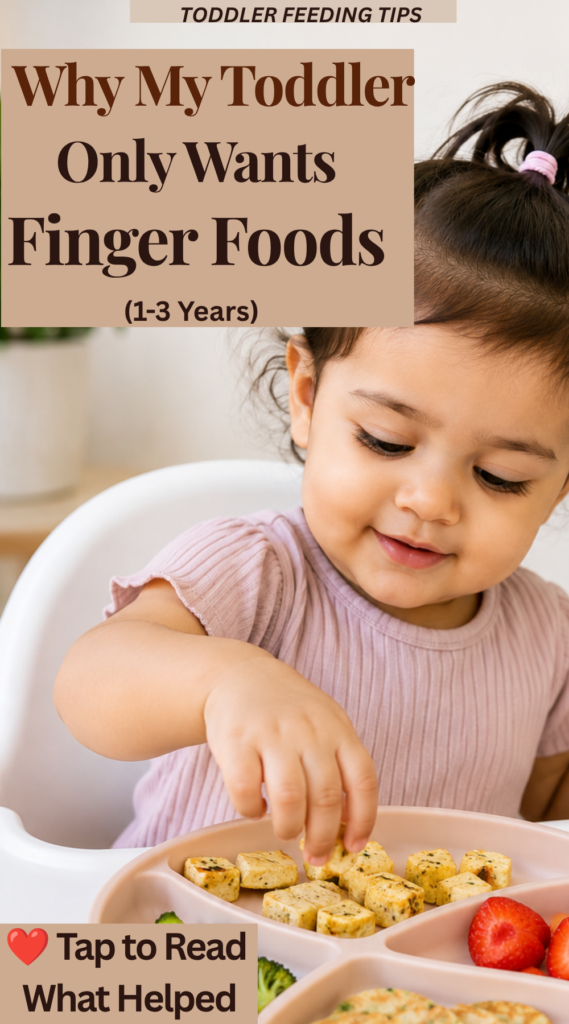
For a while, I kept wondering why my toddler would happily pick up small pieces of food with her fingers but refuse the same meal if I offered it with a spoon.
At first, I thought she was becoming a picky eater.
But as I watched her more closely, I realized she wasn’t refusing food—she was enjoying the independence of feeding herself.
Just like I shared in my posts about My Toddler Says “I’m Hungry” Then Refuses Food, Why My Toddler Suddenly Stopped Finishing Meals, and What I Do When My Toddler Says “Yuck” Before Even Tasting Food, understanding the reason behind the behavior made mealtimes much more enjoyable.
Here’s what helped us.
1. I Learned That Self-Feeding Is Part of Development
Toddlers love doing things on their own.
Picking up food with their fingers helps them practice:
- Hand-eye coordination
- Fine motor skills
- Independence
- Confidence during meals
Once I understood this, I stopped worrying about the spoon being ignored.
2. Finger Foods Gave My Toddler More Control
Toddlers enjoy making their own choices.
Being able to pick up each piece of food made eating feel more fun and less like something someone else was controlling.
I noticed my toddler often ate more when she could feed herself.
3. I Started Serving More Toddler-Friendly Foods
Instead of expecting every meal to be spoon-fed, I included foods that were easy to hold, such as:
- Soft vegetable sticks
- Small fruit pieces
- Paneer cubes
- Mini idlis
- Steamed sweet potato
- Soft cooked vegetables
Offering age-appropriate finger foods made meals much smoother.
4. I Didn’t Force the Spoon
For a while, I kept encouraging the spoon.
Eventually I realized my toddler would learn to use it with practice.
Allowing finger foods during this stage reduced frustration for both of us.
5. I Made Mealtimes About Learning
Toddlers often explore food before eating it.
They may:
- Pick it up
- Touch it
- Smell it
- Move it around the plate
I learned that this exploration is a normal part of learning to eat.
6. I Balanced Finger Foods With Family Meals
Although finger foods became a favorite, I still offered a variety of family meals.
Some meals included finger foods alongside foods eaten with a spoon.
This helped my toddler gradually become comfortable with different textures and eating styles.
7. I Focused on Nutrition, Not Just How She Ate
At first I worried because my toddler wasn’t using utensils much.
Then I realized the important question wasn’t:
“Is she using a spoon?”
It was:
“Is she eating a balanced variety of nutritious foods?”
That small change in mindset helped me relax.
What Helped Us Most
The biggest lesson I learned was that wanting finger foods wasn’t a problem—it was a sign that my toddler wanted more independence.
Instead of fighting the phase, I supported it safely while continuing to offer a variety of healthy foods.
That made mealtimes much happier for both of us.
Recommended Products
- Divided Toddler Plate
- Silicone Spoon & Fork Set
- Spill-Proof Snack Cup
- Insulated Food Jar
- Toddler Suction Plate
Affiliate Disclosure
Tiny Tummy Meals may recommend products and resources that could be helpful for parents and toddlers. If affiliate links are included in the future, they will be clearly identified. I only recommend products that I genuinely believe may be useful for families.
Medical Disclaimer
The information shared on Tiny Tummy Meals is for educational and informational purposes only and should not be considered medical advice. Every child is different. Please consult your pediatrician or a qualified healthcare professional regarding any concerns about your child’s health, nutrition, growth, or feeding habits.