
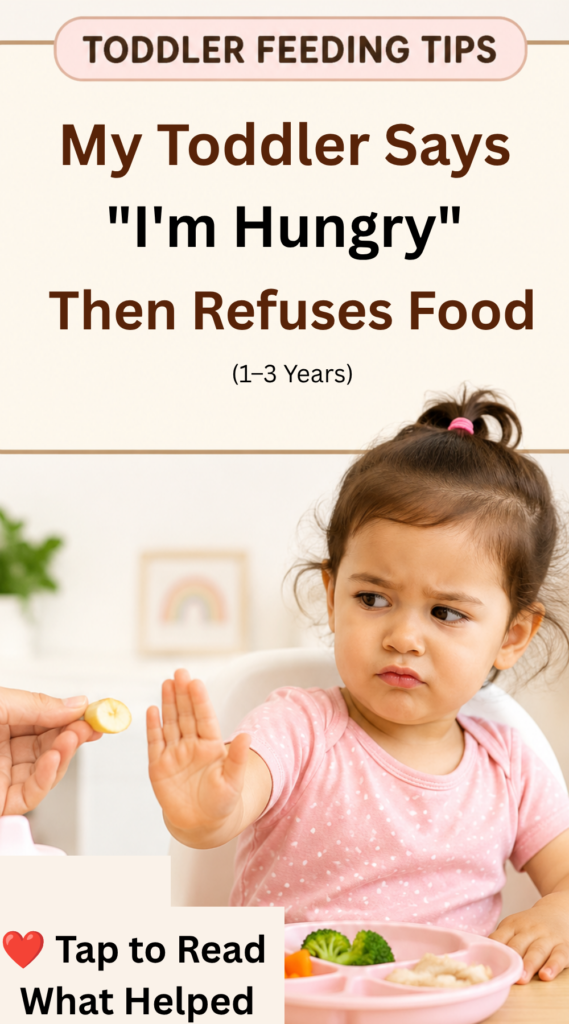
Have you ever heard your toddler say:
“I’m hungry!”
So you stop what you’re doing, prepare a meal or snack, place it in front of them, and then…
They refuse to eat it.
My toddler went through this phase too, and honestly, it was one of the most confusing feeding challenges. If she was hungry, why wasn’t she eating?
Over time, I realized there were several possible reasons behind this behavior.
Just like I shared in my posts about Why My Toddler Suddenly Stopped Finishing Meals, What I Do When My Toddler Asks for Food But Then Won’t Eat It, and What I Do When My Toddler Says “Yuck” Before Even Tasting Food, understanding the reason behind the behavior helped me stay calmer during mealtimes.
Here are the things that helped us.
1. Sometimes My Toddler Wanted a Specific Food
I learned that when toddlers say they’re hungry, they may already have a certain food in mind.
When I offered something different, the answer was often:
“No.”
This didn’t always mean my toddler wasn’t hungry. Sometimes it simply meant she was hoping for another food.
2. Hunger Can Change Quickly
Toddlers have small stomachs and short attention spans.
There were times when my toddler asked for food, but then became distracted by a toy, book, or activity before the food arrived.
By the time the meal was ready, eating was no longer her priority.
3. I Started Offering Smaller Portions
Large portions sometimes felt overwhelming.
I noticed that a small snack-sized serving often seemed more inviting than a full plate.
If my toddler wanted more, I could always offer another portion.
4. Tiredness Often Played a Role
When my toddler was tired, hungry, and cranky at the same time, food refusal became much more common.
Even favorite foods were sometimes rejected.
Checking sleep and nap schedules helped me understand some of these difficult mealtime moments.
5. I Avoided Offering Too Many Alternatives
At first, I would keep offering different foods:
- Banana
- Crackers
- Fruit
- Yogurt
Nothing seemed to work.
Eventually I learned that constantly replacing meals often created more confusion.
Now I try to stay calm and keep the original food available.
6. I Focused on Routine
Toddlers often do well with predictable meal and snack times.
Having a regular routine helped reduce random food requests throughout the day.
It also made it easier for my toddler to arrive at meals genuinely hungry.
7. I Stopped Taking It Personally
This was a big one.
When my toddler refused food after asking for it, I sometimes felt frustrated.
But I learned that toddler eating habits are rarely personal.
Their appetite, mood, energy level, and attention can change quickly.
8. I Look at the Bigger Picture
Instead of focusing on one refused meal, I try to look at:
- What my toddler ate today
- What she ate yesterday
- Her growth
- Her energy levels
- Her overall health
This helps me worry less about individual meals.
What Helped Us Most
The biggest change happened when I stopped assuming that “I’m hungry” always meant my toddler was ready to eat immediately.
Sometimes she was:
- Curious about food
- Distracted
- Tired
- Looking for a specific favorite food
Understanding the reason behind the behavior helped make mealtimes much less stressful.
Recommended Products
- Divided Toddler Plate
- Toddler Water Bottle
- Silicone Spoon & Fork Set
- Insulated Food Jar
- Spill-Proof Snack Cup
Affiliate Disclosure
Tiny Tummy Meals may recommend products and resources that could be helpful for parents and toddlers. If affiliate links are included in the future, they will be clearly identified. I only recommend products that I genuinely believe may be useful for families.
Medical Disclaimer
The information shared on Tiny Tummy Meals is for educational and informational purposes only and should not be considered medical advice. Every child is different. Please consult your pediatrician or a qualified healthcare professional regarding any concerns about your child’s health, nutrition, growth, or feeding habits.